
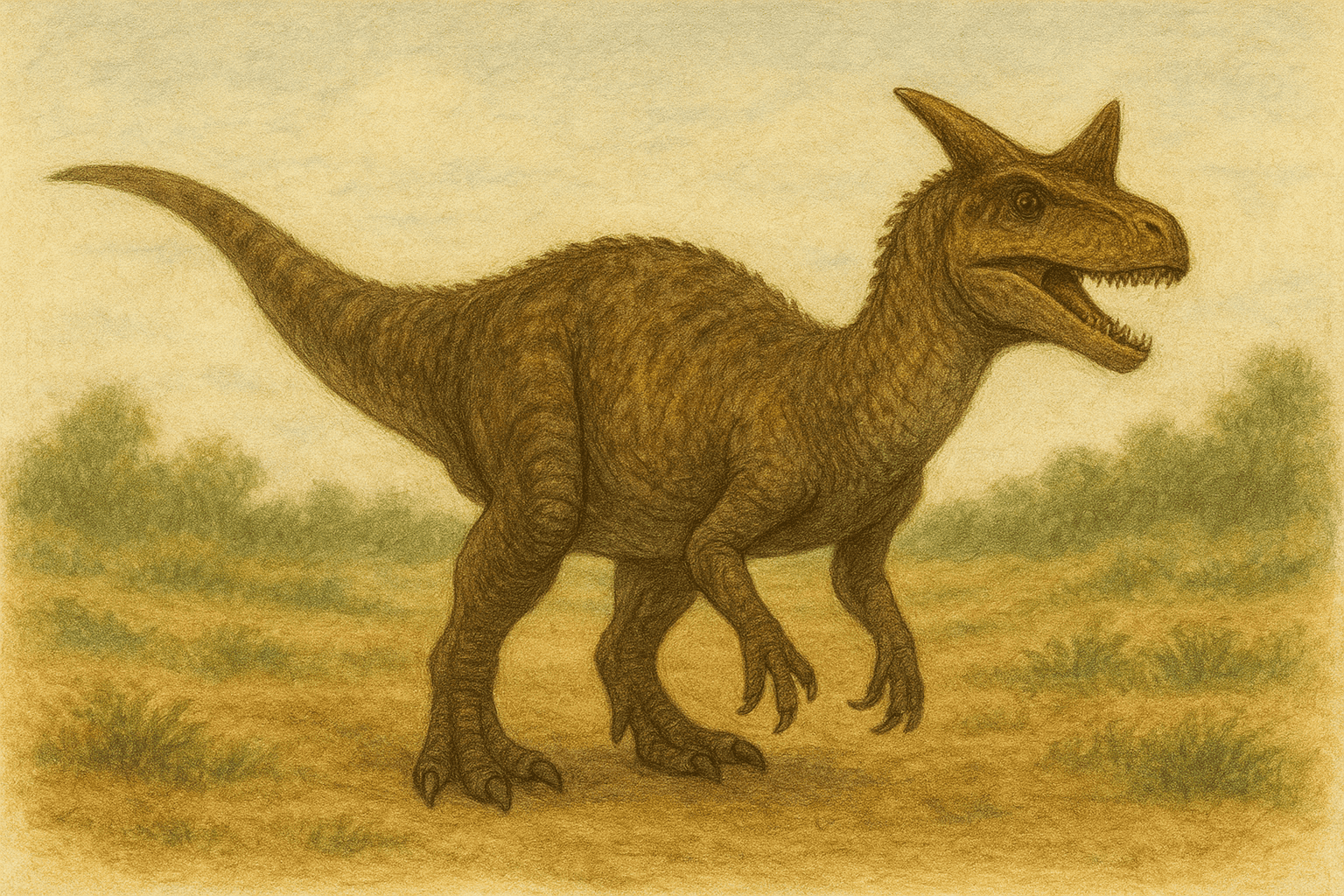
Picture a Late Cretaceous predator the size of a large horse, sprinting across open Patagonian floodplain. No enormous grasping arms. No bone-crushing jaw. Just speed, two brow horns, and a skull shaped more like a bulldog’s than a crocodile’s. Everything about this animal says it was built to run things down — and the skeleton backs that up.
The Carnotaurus dinosaur didn’t follow the standard large theropod blueprint. Where Giganotosaurus went big and powerful, Carnotaurus went fast and precise. That’s not a lesser strategy. In the right ecosystem, it’s a better one.
The Patagonian Find That Gave Us Skin and Bone
Carnotaurus sastrei was formally described in 1985 from a single specimen pulled from Patagonia’s La Colonia Formation. The skeleton was remarkably complete for a large South American theropod — but the real value of the find wasn’t the bones. It was the skin.
Large patches of fossilized skin came with the skeleton, showing rows of rounded, non-overlapping scales across the body with larger conical scales scattered among them. For a non-avian theropod of this size, direct skin evidence is exceptionally rare. Most large predator reconstructions are educated guesses at the surface level. Carnotaurus is one of the few where we actually know something.
That single specimen is still the primary reference for every reconstruction produced since 1985. Working from one individual has obvious limitations — individual variation, age, sex differences are all unknowns — but what that skeleton provided in depth of detail more than compensates. It’s one of the most information-dense single finds in South American paleontology.
Reading the Skull Honestly
The Carnotaurus skull is short and deep — blunt-faced by large theropod standards, with a jaw profile that looks compressed rather than elongated. Biomechanical analysis of the jaw structure points toward speed over force: the muscles were arranged for rapid opening and closing rather than sustained crushing pressure. This animal couldn’t lock onto prey the way a T. rex could. It struck fast and repeatedly instead.
The brow horns are the feature most people ask about, and the honest answer is that their function is still genuinely debated. Display is the most commonly cited hypothesis — species recognition, mate competition, or both. Some researchers have proposed they absorbed impact during head-to-head confrontations between individuals, though the geometry makes that mechanically awkward. I think display is the stronger argument, but that’s an inference from analogy with living horned animals, not a conclusion the fossil record forces on us.
The skull’s key features and what they imply:
- Short, deep snout — unusual for a large theropod; creates the distinctive bull-faced profile that makes Carnotaurus immediately recognizable
- Bony brow horns — confirmed directly by fossil evidence, likely display structures, function still actively researched
- Fast jaw mechanics — rapid repeated strikes rather than the sustained grip-and-crush bite of Giganotosaurus or T. rex
- Severely reduced forelimbs — among the smallest arms relative to body size of any large theropod; the skull and legs did all the predatory work
The Speed Case — What the Legs Actually Show
The speed argument for Carnotaurus isn’t speculation — it’s structural. The hind limbs show elongated shin and foot bones relative to the femur, a pattern that appears consistently in fast-running animals across different lineages. Long distal segments reduce the energy cost per stride and allow faster leg turnover. You see the same ratio in ostriches, roadrunners, and the limbs of sprinting ungulates.
Biomechanical modelling estimates vary, but the structural case holds regardless of the specific number. What matters for understanding the animal is the principle: Carnotaurus was optimized for closing distance quickly, not for sustained pursuit over long distances. That’s an ambush and acceleration profile, similar to a cheetah rather than a wolf.
The reduced arms fit this perfectly. Grasping forelimbs are useful for animals that wrestle prey to the ground. For a predator whose strategy was to sprint, strike, and retreat, arms were dead weight. Losing them meant more metabolic resources directed toward the legs — a trade-off that only makes sense if speed was the primary tool, which the limb proportions confirm.
Prehistoric Planet and What Good Reconstruction Looks Like
The Prehistoric Planet Carnotaurus sequences changed how a lot of people see this animal. The production worked with paleontological consultants to depict Carnotaurus with skin texture consistent with the fossil record, movement mechanics that reflected the biomechanical data, and display behavior modeled on living relatives rather than invented for drama.
The display sequences — showing potential skin color change and postural signaling — are speculative, but they’re grounded in plausible analogy with living reptiles that use similar mechanisms. That’s the right kind of speculation: clearly framed as inference, rooted in biological precedent, and serving the goal of showing an animal behaving like a living creature rather than a walking prop.
What Prehistoric Planet demonstrated is that audiences respond to accuracy. The episodes that generated the most discussion weren’t the ones with the biggest animals — they were the ones where familiar animals were shown doing something unexpected and scientifically defensible. Carnotaurus was a strong example of that, and it shifted the popular image of the animal meaningfully.
Why the Schleich Figure Earns Its Shelf Space
The Schleich Carnotaurus is one of the more defensible choices in the dinosaur model market, and the reason comes down to what Carnotaurus actually looks like. The horns, the blunt face, the almost comically small arms — these are features that a figure either gets right or obviously gets wrong. There’s no hiding a bad reconstruction behind generic theropod proportions.
A figure that reflects the skin texture evidence — the rounded scales, the conical osteoderms — is carrying the fossil record into physical form in a way that most dinosaur models never manage. The Patagonian specimen gave us that information. A model that uses it is doing something genuinely educational rather than just decorative.
For anyone building a collection around what paleontology actually knows rather than what looks impressive on a shelf, Carnotaurus is a strong anchor. It’s one of the best-documented large theropods from South America, and a well-made figure communicates that story without needing a caption.
Where Carnotaurus Sits in the Larger Story
South American theropods operated in geographic isolation for much of the Cretaceous. The continent was an island landmass during this period, cut off from North America, which meant its predator lineages evolved independently from the tyrannosaurs that came to dominate the north. Carnotaurus is the most visible product of that separate evolutionary path — a large predator that arrived at completely different anatomical solutions to the same ecological problem.
What the Carnotaurus dinosaur specifically adds to the record:
- Speed as a primary large predator strategy — a direct structural contrast to the power-and-grip approach of northern tyrannosaurs
- Skin impression evidence for a large non-avian theropod — one of very few large predators where surface texture is documented rather than assumed
- Abelisaurid success across Gondwana — Carnotaurus is the most famous member of a family that dominated southern predator niches while tyrannosaurs ruled the north, a geographic split that tells us a lot about how isolation drives divergent evolution
Carnotaurus didn’t need to be the largest carnivore in the Cretaceous to be effective. In its own ecosystem, on its own continent, its specific combination of speed, strike mechanics, and unusual skull design made it exactly what the environment selected for.
The most effective design is rarely the most obvious one. Carnotaurus has been making that argument for 80 million years.