
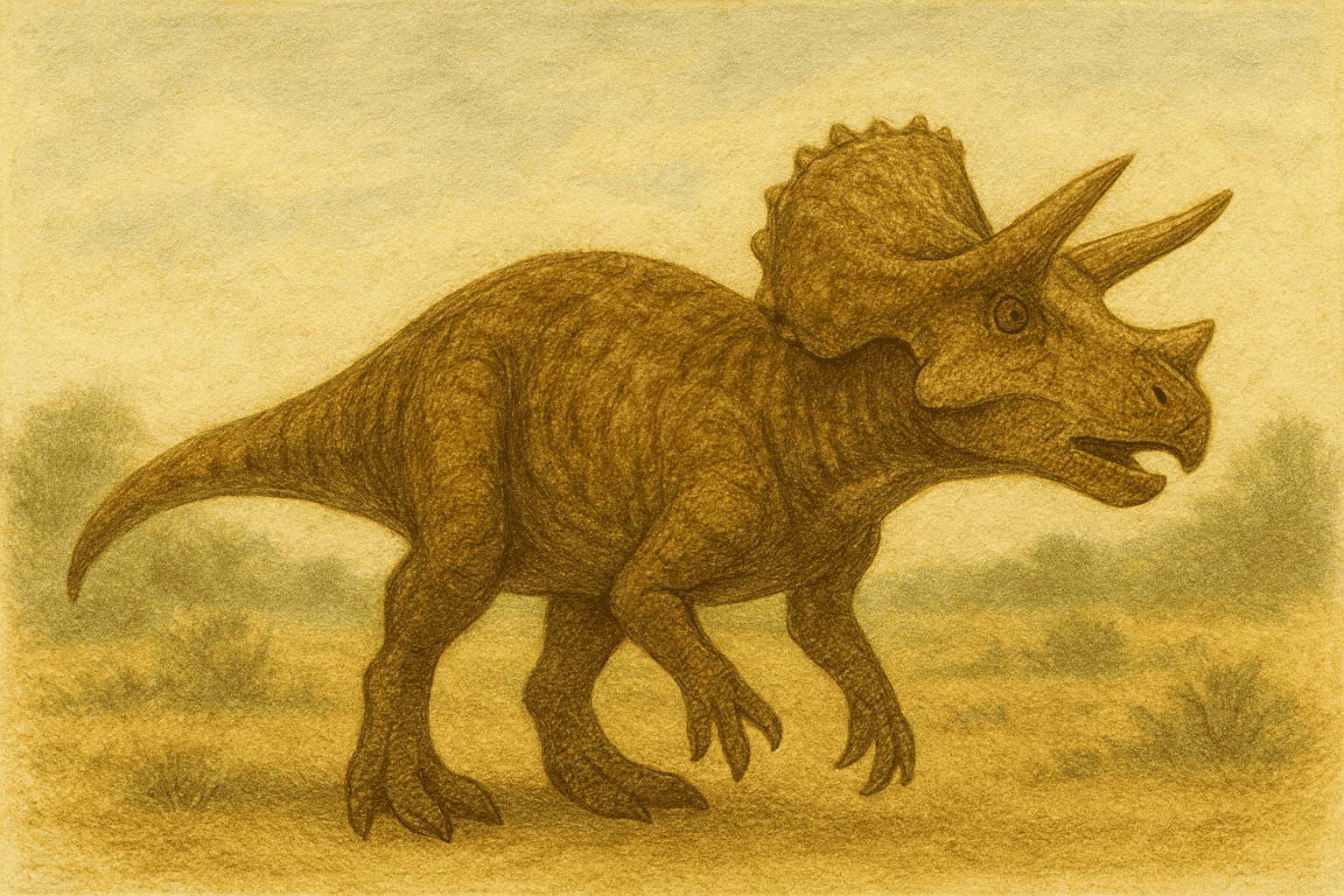
Walk into any natural history museum and there’s a good chance Triceratops is near the entrance. Not because it’s the largest dinosaur or the most dangerous — but because its silhouette does something almost no other extinct animal can: it registers immediately, even to someone who couldn’t name another species.
That recognition is earned. The Triceratops dinosaur is one of the best-documented animals in the entire fossil record, one of the last non-avian dinosaurs to exist before the end-Cretaceous extinction, and one of the few large prehistoric herbivores we can study in genuine anatomical depth. The popular image — horned tank, passive grazer, T. rex prey — undersells it considerably.
Right at the End of Everything
Triceratops existed between roughly 68 and 66 million years ago, in the final geological window before the Chicxulub impact ended the non-avian dinosaur lineages. It wasn’t an early or intermediate ceratopsid — it was the endpoint of the lineage, appearing late and surviving right up to the boundary.
The ceratopsid family it belonged to produced some genuinely varied animals — Styracosaurus with its radiating frill spikes, Pentaceratops with its enormous frill, Centrosaurus with its elaborate nasal horn ornament. Every dino like Triceratops in that lineage found its own variation on the horn-and-frill theme. Triceratops was the heaviest and most structurally solid version of the design, which is part of why it outlasted most of its relatives.
The fact that it made it to the very last chapter of the Cretaceous isn’t incidental. It tells you something real about how effective its body plan was under sustained predation pressure from one of the largest terrestrial carnivores that ever lived.
Three Horns, One Frill, Multiple Jobs
The dino with three horns label is the most common entry point, and it’s worth being precise about what those horns actually were. The two brow horns — above the eyes — could exceed three feet in large adults. The nasal horn was shorter and more variable between individuals. The large bony frill extending from the back of the skull wasn’t a separate structure but continuous with the skull itself, braced by the neck musculature that had to support the whole assembly.
Scientific thinking on horn function has moved away from single-purpose explanations. Healed wounds on Triceratops bones include horn puncture damage consistent with intraspecific combat — Triceratops fighting other Triceratops — as well as bite marks matching T. rex tooth dimensions on the same specimens. The same animal was apparently fighting its rivals and surviving predator attacks. The horns weren’t specialized for one scenario.
Bull elk use their antlers primarily against other elk during rut, and will turn them on predators when forced to. The behavioral logic maps cleanly onto Triceratops. What I find most compelling here is the frill component: vascular channels in well-preserved frills suggest it may have been capable of flushing with color — making it an active display structure, not passive armor. That shifts the picture from “tank” to something considerably more expressive.
The Anatomy Underneath the Headlines
The dino Triceratops reached up to 30 feet in length and somewhere between 6 and 12 tons — a range that reflects genuine individual variation in the fossil record, not measurement uncertainty. That’s roughly the mass of a modern white rhinoceros scaled up five or six times, and the structural parallels in leg architecture are real: column-like limbs built to carry significant weight across uneven terrain.
The functional anatomy beyond the horns:
- Parrot-like beak at the jaw tip — handled the initial cropping of tough vegetation before passing material back to the cheek teeth
- Continuously replacing dental batteries — stacked columns of teeth that wore down and renewed throughout life, maintaining a functional grinding surface at all times
- Robust neck musculature anchored to the frill — the skull assembly including horns and frill could weigh over a ton; the frill served as a structural anchor for the muscles carrying that load
- Column-like forelimbs with a slight outward splay — the exact posture has been debated, but current evidence supports a more upright stance than older reconstructions showed
The dental battery point is one I think deserves more attention than it gets in popular coverage. Triceratops could process plant material — particularly the tough, fibrous vegetation of Late Cretaceous North America — that most large herbivores of its era couldn’t handle as efficiently. That dietary range reduced competition and gave herds access to food sources others passed over.
The Spinosaurus Contrast — Same Period, Different Planet
Spinosaurus was doing something almost entirely opposite to Triceratops on the other side of the world. Semi-aquatic, fish-hunting, built with dense bones for buoyancy and a crocodilian skull optimized for grabbing slippery prey in North African river systems — it represents one of the most radical departures from the standard large theropod plan ever documented.
The two animals shared a geological period but nothing else. Different continents, different prey, different body plans, different ecological roles. What makes that comparison useful isn’t a hypothetical fight — it’s the illustration of how far Cretaceous evolution had diverged across geographic boundaries by the time these animals existed. Triceratops was the product of isolated North American evolution under heavy tyrannosaur predation. Spinosaurus was the product of isolated African evolution around an entirely different resource base.
Put them side by side and you have a snapshot of how different the same planet looked from opposite sides 70 million years ago.
What the Fossil Record Has Actually Produced
The Hell Creek Formation — stretching across Montana, North Dakota, and South Dakota — has produced more Triceratops material than almost any other large dinosaur from any formation anywhere. Dozens of skulls, multiple near-complete skeletons, isolated elements across the full growth range. That density of material is what makes real population-level science possible.
The pathology evidence alone is remarkable. Healed horn cores, frill perforations, bite marks with identifiable tooth spacings — the bones carry a physical record of what this animal actually went through during its lifetime. That’s not reconstruction or inference. It’s documentation of real events in specific animals’ lives, preserved in stone.
There’s also the unresolved Torosaurus question. Some researchers argue that Torosaurus — long classified as a separate ceratopsid — is actually a mature growth stage of Triceratops, based on bone texture and frill morphology changes across ontogeny. Others push back. The debate is active and unresolved, which means fundamental questions about how Triceratops changed across its lifespan are still being worked out in peer-reviewed literature right now.
Why the Research Keeps Coming
The Triceratops dino has been generating scientific papers continuously since the 1880s, and the rate hasn’t slowed. New specimens, new analytical techniques, and new theoretical frameworks keep producing findings. That’s the benefit of a fossil record this rich — there’s always more material to interrogate.
What the current research literature keeps circling back to:
- Horn function was multimodal — defense, intraspecific combat, and social display, operating simultaneously rather than as competing hypotheses
- Frill vascularization suggests active signaling — the frill may have flushed with color, which changes how we understand social behavior in this animal entirely
- T. rex interaction is documented, not just inferred — bite marks and healed wounds provide direct physical evidence of encounters between the two species
- The Torosaurus question remains genuinely open — the ontogeny debate has real implications for how we count ceratopsid diversity at the end of the Cretaceous
Triceratops made it to the final day of the non-avian dinosaur era. It was still there, still evolving, still producing variation in its horns and frills and dentition, when the Chicxulub impact ended the lineage entirely. The fossil record it left behind is dense enough that we’re still finding things in it 140 years after the first specimens were described.
Three horns. Sixty-six million years. Still not done telling us things.