
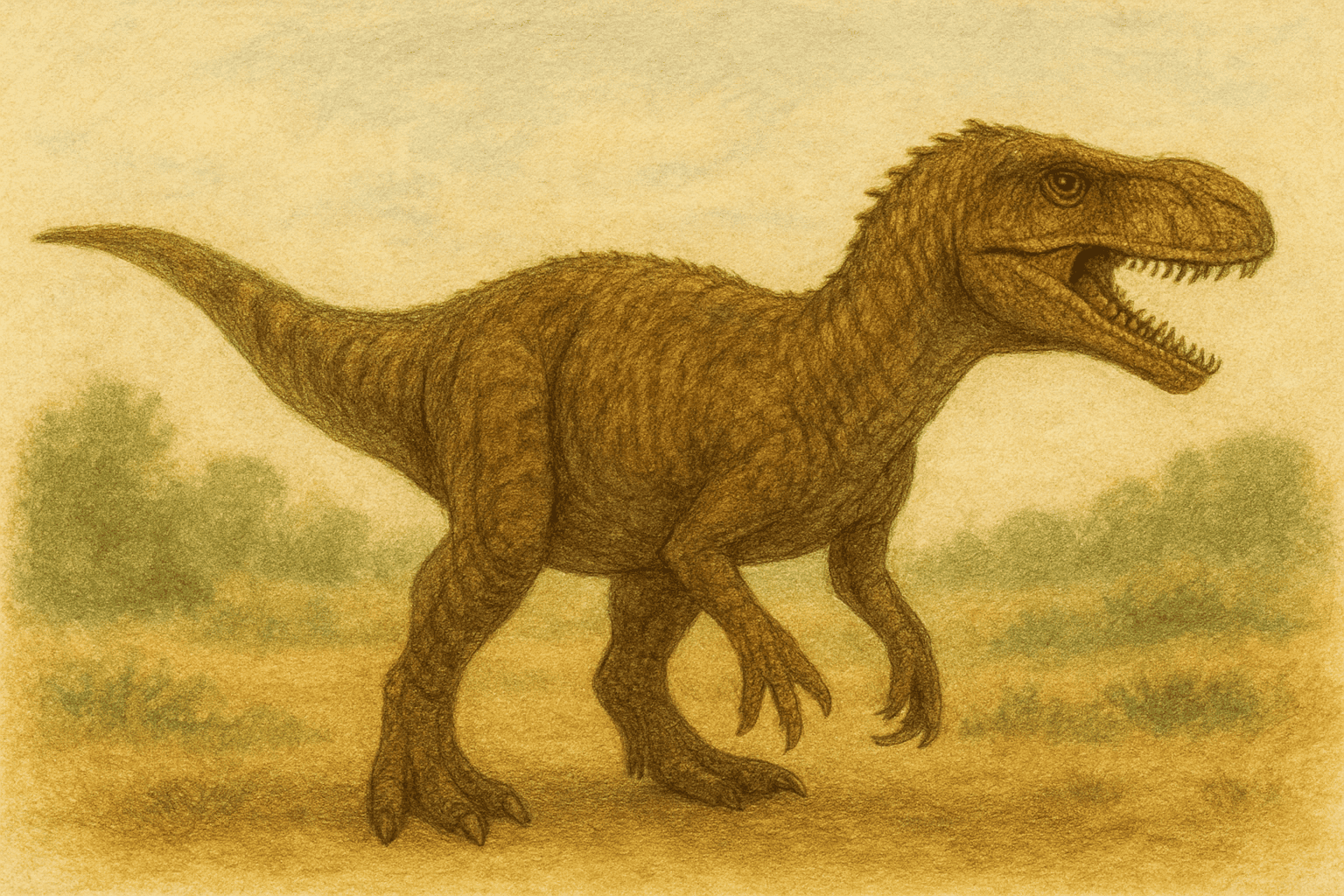
Ask most people to name the largest carnivorous dinosaur and you’ll get T. rex nine times out of ten. That’s cultural momentum at work, not necessarily the science. Because 30 million years before Tyrannosaurus turned up in North America, something comparable in size — and arguably more interesting anatomically — was already at the top of the food chain in Patagonia.
The Giganotosaurus dinosaur was over 40 feet long, around 8 tons, with a skull nearly 6 feet from snout to back of the cranium. It didn’t evolve in T. rex’s shadow. It solved the apex predator problem independently, on a different continent, against completely different prey — and the solution it arrived at tells a more interesting story than the size comparison alone.
How It Was Found — and Why That Story Matters
In 1993, Rubén Carolini — an amateur fossil hunter with no professional training — spotted bones eroding from the ground near Plaza Huincul in Neuquén Province, Argentina. He reported it to the Carmen Funes Museum rather than keeping the find to himself, which is how these things should go and often don’t. Professionals excavated, and what came out reordered the list of the largest known carnivorous dinosaurs.
The specimen — roughly 70 percent complete — provided a skull, most of the vertebral column, and enough limb material for reliable size estimates. It became the holotype for Giganotosaurus carolinii, the species name honoring Carolini directly. The formal description published in 1995 confirmed what measurements suggested: this was a theropod that exceeded any T. rex specimen known at the time in overall length.
The Carolini story is worth telling properly because it’s a reminder that significant paleontological finds don’t require institutional backing to start — they require someone paying attention to what’s already coming out of the ground, and then doing the right thing with it.
An Anatomy Built for a Different Kind of Hunting
Most large theropod comparisons stall at skull size and body length. The more useful comparison is functional anatomy — what was each animal actually built to do? Giganotosaurus and T. rex were not solving the same hunting problem, and their bodies reflect that.
The structural profile that defined Giganotosaurus as a hunter:
- Long, narrow skull — built for fast slashing bites rather than the bone-crushing sustained grip of T. rex; caused damage through repeated contact rather than a single clamp
- Serrated blade-like teeth — optimized for cutting through flesh and causing blood loss over time, not fracturing bone the way tyrannosaur teeth did
- More elongated, lighter body — less stocky than T. rex, with proportions that suggest greater speed and terrain coverage
- Longer legs relative to body mass — consistent with an animal that moved efficiently across open ground rather than relying on short-range ambush
The slashing bite deserves more attention than it usually gets. If your prey weighs 70 tons — as Argentinosaurus may have — locking onto it and holding is both mechanically difficult and physically dangerous. A strategy based on repeated cutting strikes that cause cumulative damage without requiring sustained contact is tactically more sensible. That’s not a compromise. That’s an adaptation specifically suited to the prey available in Late Cretaceous Patagonia.
The Prey: Hunting the Largest Land Animals That Ever Lived
Argentinosaurus is the animal most often paired with Giganotosaurus in the ecological picture, and the pairing is legitimate — both come from the Neuquén Basin in broadly the same geological timeframe. Size estimates for Argentinosaurus vary between studies, but most put it somewhere between 65 and 80 tons. The largest African elephant alive today weighs around 6 tons. Scale that up eleven or twelve times and you have a rough sense of what Giganotosaurus may have been hunting.
There is a bone bed in Argentina interpreted as containing multiple Giganotosaurus individuals — which has been cited as evidence for group behavior. Whether that represents coordinated hunting or opportunistic scavenging at a shared carcass is genuinely unresolved. But the ecological logic for some form of group tolerance at least makes sense: no single 8-ton predator takes down a healthy adult titanosaur alone without absorbing serious injury risk in the process.
I find this aspect of Giganotosaurus ecology the most underexplored in popular coverage. The prey-to-predator mass ratio it faced was unlike anything T. rex dealt with, and understanding how it managed that gap is more revealing than any size comparison between the two predators.
The T. rex Comparison — What It Actually Illuminates
The head-to-head framing is everywhere and ultimately beside the point — these animals were separated by 30 million years and the width of two continents. They never met. But the comparison does something useful when it’s done right: it shows how geographic isolation produces divergent engineering solutions to similar ecological problems.
T. rex was built for bone-crushing, ambush-optimized predation against large but relatively manageable prey like Edmontosaurus and Triceratops. Triceratops in particular — heavily armored, horned, and capable of active defense — represented the kind of prey that selected for raw bite force and robust skull architecture. Giganotosaurus never faced anything like it. Its prey was vastly larger but essentially passive once it was injured. Completely different selection pressures, completely different results.
Neither animal was universally superior. Each was well-calibrated for its own continent, its own prey base, and its own set of competitive pressures. The comparison is most valuable not as a ranking exercise but as a window into how the same ecological role — apex predator — can be filled by radically different designs.
The Size Claim — Handled Honestly
The Giganotosaurus biggest dinosaur framing circulates widely, and it needs some qualification to be useful. In terms of overall body length among bipedal land predators, Giganotosaurus is a genuine contender — current estimates put it at 40 to 43 feet. Spinosaurus was longer but semi-aquatic, which changes the comparison. Among strictly terrestrial pursuit predators, the competition for the top slot is real.
What’s not in dispute is the quality of the Giganotosaurus fossils themselves. At roughly 70 percent skeletal completeness, the holotype is better preserved than many comparable large theropods, which means size estimates carry more confidence than they do for animals known only from fragments. When researchers argue about a Giganotosaurus’s dimensions, they’re arguing from real material — not extrapolating from three bones and a tooth.
That evidential foundation is what makes Giganotosaurus a serious scientific subject rather than just a size claim. The fossil record is good enough to support real conclusions, and ongoing work in the Neuquén Basin continues to add to it.
What This Animal Represents Beyond the Size Debate
South American Cretaceous paleontology has produced some of the most significant large theropod finds of the past three decades, and Giganotosaurus sits near the top of that list. The broader point it represents is one that popular coverage still underweights: the southern continents were not secondary stages running behind the northern evolutionary script. They were independent experiments, operating under different ecological pressures, producing genuinely different animals.
What Giganotosaurus specifically adds to that record:
- The slashing bite as a viable large predator strategy — distinct from the grip-and-crush approach, better suited to oversized prey, and independently arrived at across multiple theropod lineages
- Titanosaur-driven predator evolution — the presence of the largest land animals ever recorded almost certainly selected directly for Giganotosaurus’s size and hunting method
- Geographic isolation as an evolutionary engine — South America’s separation from North America during this period produced predator lineages with no northern equivalent, and Giganotosaurus is the most visible result
T. rex will keep the headlines. It has too much cultural infrastructure behind it to be displaced by a more accurate ranking. But Giganotosaurus makes a case that doesn’t depend on beating T. rex in a comparison — it’s interesting on its own terms, in its own ecosystem, doing things the northern predators never had to figure out.
The southern giant got there first. It just took us longer to find it.