
Watch a brown bear fish a river. It stands in the current, perfectly still, then moves with a speed that looks wrong for something that size. One strike, one fish. The whole sequence takes less than a second.
Now scale that up. Thirty feet long. A curved claw nearly twelve inches from base to tip. A skull shaped like a gharial’s, packed with conical teeth designed for grip rather than shear. That’s roughly what stood at the edge of an Early Cretaceous river in what is now Surrey, England, about 130 million years ago.
The Baryonyx was not the dinosaur anyone expected to find. And that’s exactly what makes it worth understanding.
One Claw Changed Everything
In 1983, an amateur collector named William Walker spotted something unusual in a clay pit near Dorking, Surrey. The object turned out to be a massive, curved claw — big enough that Walker brought it to the Natural History Museum in London rather than trying to identify it himself. That decision led to a full excavation and one of the most complete theropod skeletons ever recovered in the UK.
When researchers examined the stomach region, they found fossilized fish scales and fish bones. They also found partial remains of a young Iguanodon. So Baryonyx wasn’t a pure fish specialist — it was an opportunist that leaned heavily toward aquatic prey but would take what was available. That nuance often gets lost when people describe it simply as “a fishing dinosaur.”
The name they settled on was Baryonyx walkeri — “heavy claw,” with the species name honoring the man who found it. It’s one of the better naming decisions in paleontology. Walker’s instinct to bring that claw to professionals rather than keep it as a curiosity is the reason we know this animal exists at all.
An Anatomy That Tells Its Own Story
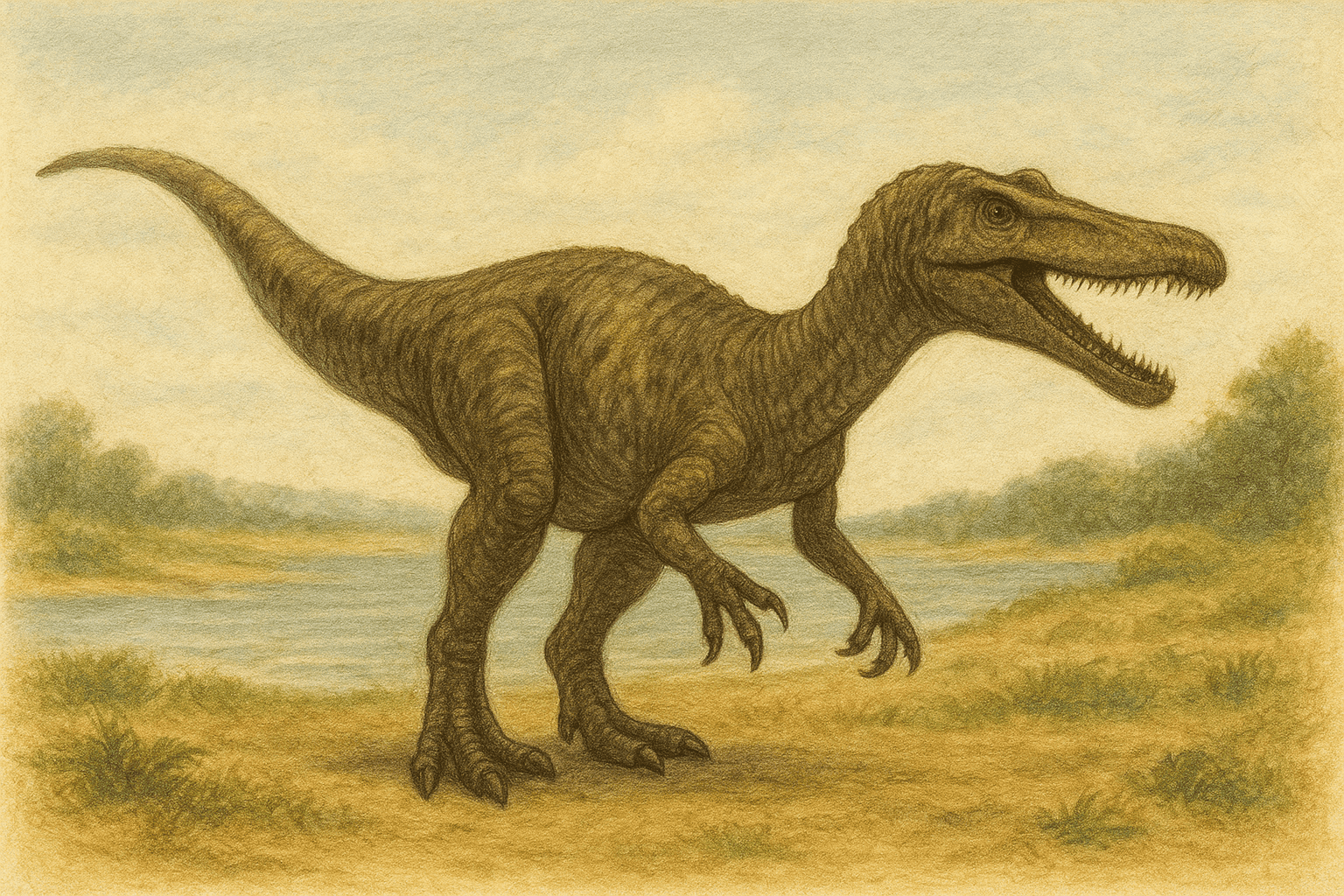
The skull is the first thing worth studying in any Baryonyx reconstruction. It’s long, low, and narrow — around three feet in length in adults — with a characteristic spoon-shaped rosette of enlarged teeth at the tip of the lower jaw. Crocodilians use that same feature to grip slippery, struggling fish. Baryonyx arrived at the same solution through a completely separate evolutionary path.
The rest of the skeleton reinforces the same picture:
- Hand claws nearly 12 inches long — proportionally far larger than other theropods of similar size, purpose-built for hooking prey
- Nostrils positioned well back from the snout tip — a consistent trait in animals that regularly submerge their jaws
- Robust forelimbs relative to body size — unusually strong for a theropod, suggesting the arms did real work rather than serving as vestiges
- S-curved neck — similar to herons and other wading birds that use a rapid strike motion to catch fish
Every feature points in the same direction. That kind of anatomical consistency is actually rare in fossil animals, and it’s why Baryonyx remains such a clean case study in how form follows function in predator evolution.
Two Predators, One Ecosystem, No Overlap
Baryonyx shared Early Cretaceous England with Utahraptor — a fast, intelligent, land-based pack hunter that operated in open terrain and forested environments well away from the waterline. On paper, two apex predators in the same ecosystem sounds like a recipe for conflict. In practice, they almost certainly never competed.
Baryonyx was built for riverbanks and shallow water. Utahraptor was built for pursuit across dry ground. The prey each animal targeted, the terrain each animal used, and the hunting methods each animal employed had essentially no overlap. That kind of ecological separation is precisely what allows two large predators to coexist in the same landscape without one driving the other out.
You see the same pattern today between jaguars and giant river otters in Amazonian river systems — technically competing apex predators that have divided the available resources so efficiently they rarely interact at all.
Why the Models Matter
The Baryonyx Schleich and Papo Baryonyx figures sit at the better end of the dinosaur model market, and the reason is specificity. Baryonyx has a distinctive enough anatomy — that snout, those claws, the lean frame — that a poorly researched figure is immediately obvious. Both manufacturers have done the work to get the proportions close to what the fossil record actually shows.
There’s a practical reason that accuracy matters beyond aesthetics. When a figure captures the real animal, it prompts real questions. A child holding a Baryonyx model and asking why the snout looks so different from a T. rex is already reasoning about comparative anatomy. That question has a real answer, and following it leads somewhere genuinely interesting.
The Baryonyx albino variants in custom models and fan art occupy different territory — more creative interpretation than reconstruction. Albinism occurs in living reptiles and would have been genetically possible in Mesozoic animals, so the premise isn’t scientifically absurd. It’s a useful reminder, though, that almost everything we think we know about dinosaur skin color is inference at best. The actual palette of a living Baryonyx is completely unknown, and the range of what’s plausible is far broader than most popular depictions suggest.
The Longer Legacy
Baryonyx walkeri was the first described member of the Spinosauridae — a family that would eventually include Spinosaurus, currently the largest carnivorous dinosaur known to science. Every interpretive framework we use for spinosaurid ecology, behavior, and anatomy was built on the foundation that Surrey skeleton provided in 1983.
The lasting contributions of that single find:
- Established semi-aquatic theropods as a real ecological category — not a novelty, but a viable and recurring evolutionary strategy
- Demonstrated convergent evolution at the macro scale — Baryonyx independently developed crocodilian skull architecture hundreds of millions of years after crocodilians did
- Proved gut content analysis could work in theropods — the fish remains in the stomach region opened a methodology that has since been applied across many species
The Baryonyx didn’t need to be the biggest animal in its ecosystem. It needed to be the best at one specific thing, in one specific environment. It was. And forty years after William Walker picked up that claw from a clay pit, the science it generated is still producing new findings.
Specialization, it turns out, is a strategy with a very long shelf life.