
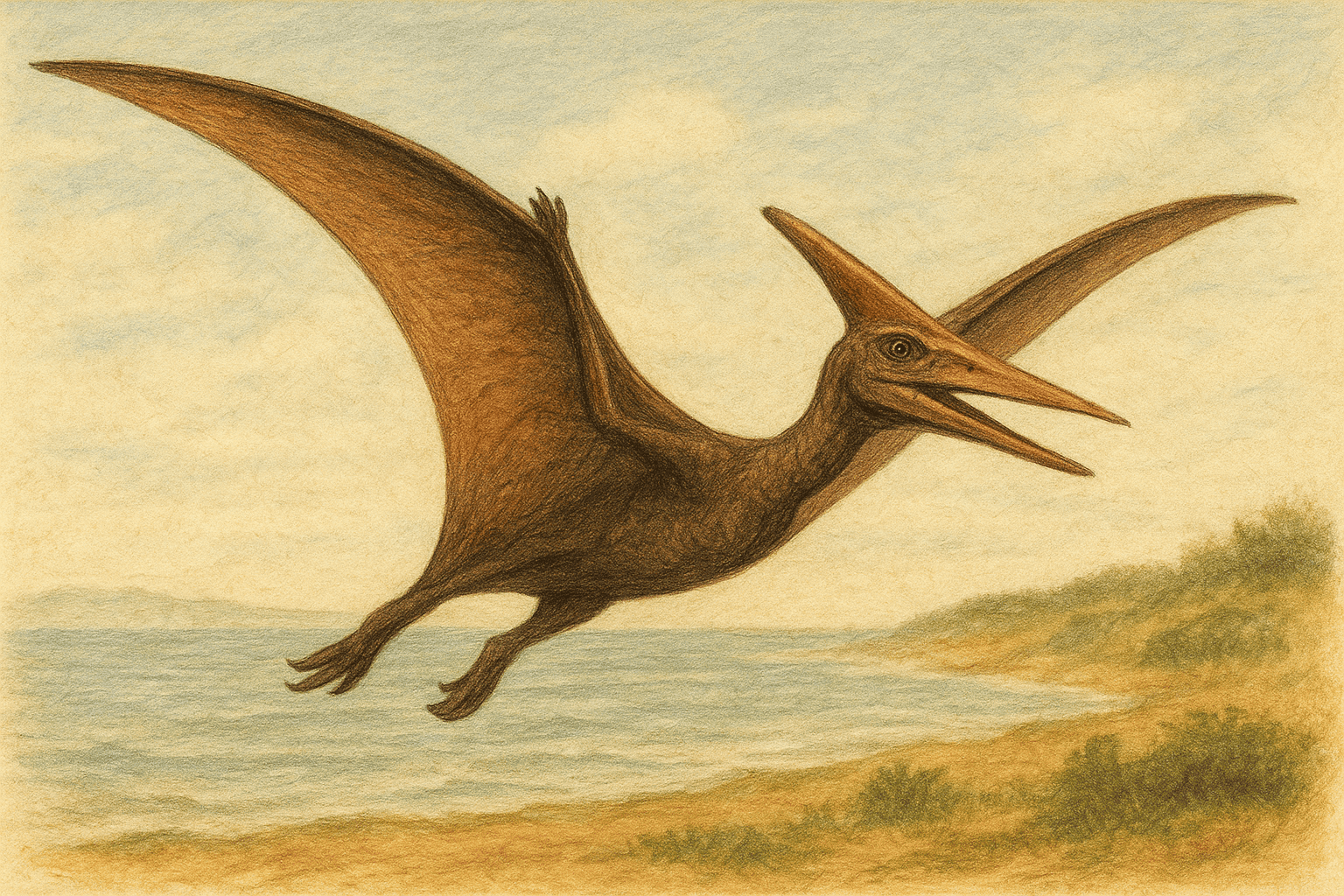
Watch a pelican work a coastline — that low, effortless glide just above the waterline, the sudden tuck and plunge when it spots a fish. Now stretch that wingspan to 20 feet, add a dramatic bony crest sweeping back from the skull, and set the whole scene 85 million years ago above an inland sea covering what is now Kansas.
That’s the dino Pteranodon. And if anything, that mental image undersells it.
Not a Dinosaur — But That Label Has Never Really Mattered
Let’s get the taxonomy out of the way. Pteranodon wasn’t a dinosaur in the technical sense. It was a pterosaur — a separate reptile lineage that developed powered flight independently, long before birds existed. Pterosaurs and dinosaurs shared a common ancestor, lived alongside each other for millions of years, and disappeared around the same time, but they were never the same thing.
The dinosaurus Pteranodon label persists in popular culture, and honestly, it’s not worth fighting. What matters is understanding what this animal actually was: a highly specialized, coastal, fish-eating flier that represents the peak of pterosaur evolution. That story is interesting enough without worrying about the classification.
If anything, the fact that it wasn’t a dinosaur makes it more impressive — an entirely separate lineage independently arriving at large-scale, sophisticated, soaring flight.
What Those Wings Were Actually Doing
The Pteranodon wings weren’t built like bird wings or bat wings. The membrane stretched from a single, massively elongated fourth finger all the way down to the body — a structure unique to pterosaurs, reinforced internally with stiff fibers called actinofibrils that gave it more rigidity and control than a simple skin flap.
Everything else in the body was engineered to keep that wingspan airborne:
- Hollow bones — the skeleton was extraordinarily light relative to its size, a prerequisite for an animal this large to fly at all
- Deep chest keel — anchored the flight muscles that powered each wingbeat
- Long, toothless beak — lighter than a toothed jaw and shaped for snatching fish cleanly from the water surface
- The crest — still debated, but likely served as both a flight stabilizer and a display structure, probably doing both jobs simultaneously
Current research suggests Pteranodon launched using all four limbs — a quadrupedal vault off the ground that gave it the initial lift needed to get those wings working. For an animal with a 20-foot wingspan, passive takeoff from a cliff edge with a strong headwind was probably the preferred option whenever available.
Pteranodon vs. Pterodactyl: The Quickest Explanation You’ll Find
The Pteranodon and Pterodactyl confusion is one of the most common in all of paleontology, and it’s an easy one to fix. “Pterodactyl” in casual conversation usually means any flying prehistoric reptile. Scientifically, it refers to Pterodactylus — a much smaller pterosaur from the Jurassic period, about 150 million years ago, with teeth and a modest crest or none at all.
Pteranodon arrived 50 to 80 million years later, was dramatically larger, had no teeth, and sported one of the most recognizable crests in the fossil record. Grouping them together is like calling a robin and a wandering albatross the same bird. Same class, completely different animals with entirely different lives.
The distinction matters because it changes how you understand each animal’s ecology, behavior, and place in evolutionary history — not just as a trivia correction.
A Life Spent Over Open Water
Almost every Pteranodon fossil ever found came from the Niobrara Formation in Kansas — the bed of an ancient inland sea called the Western Interior Seaway. That’s not a coincidence. Pteranodon was a seabird in everything but name, spending its life riding coastal thermals and hunting fish from the air the way frigatebirds and albatrosses do now.
Down in the shallower river systems feeding into that same sea, spinosaurids related to Baryonyx were hunting the same fish from water level — wading in, using their crocodile-like jaws to grab prey from below the surface. Pteranodon worked the same food source from 50 feet up. Same resource, no competition. That kind of ecological partitioning is exactly how large predators coexist without constant conflict.
Fossils also show clear size differences between males and females — males were larger with more prominent crests, females smaller and more compact. The size difference in females was almost certainly an adaptation for nesting, making it easier to manage eggs and hatchlings on narrow cliff ledges and shoreline colonies. These were not solitary animals. They lived, nested, and presumably competed for mates in large, noisy groups.
Why This Animal Still Has So Much to Teach Us
Pteranodon has been studied for over 150 years and there are still genuinely open questions — which is a sign of how scientifically rich this animal is, not how much we’ve missed.
The debates still running in the literature:
- Crest function — aerodynamic rudder, species recognition, mate attraction, or all three at once
- Takeoff mechanics — how an animal this large got airborne from flat ground is still being modeled
- Metabolism and growth rate — bone evidence suggests rapid growth more consistent with warm-blooded physiology than traditional reptile models
- Coexistence with early birds — pterosaurs and birds shared the Cretaceous sky for tens of millions of years before pterosaurs vanished entirely
The dino Pteranodon label might be scientifically imprecise. But the animal itself earned every bit of the attention it gets. It was the product of an entirely separate evolutionary experiment in flight — one that produced something genuinely extraordinary, held it in the air for tens of millions of years, and left enough behind in the rock for us to still be arguing about it today.
That’s not a creature that deserves a footnote. That’s a headline.