
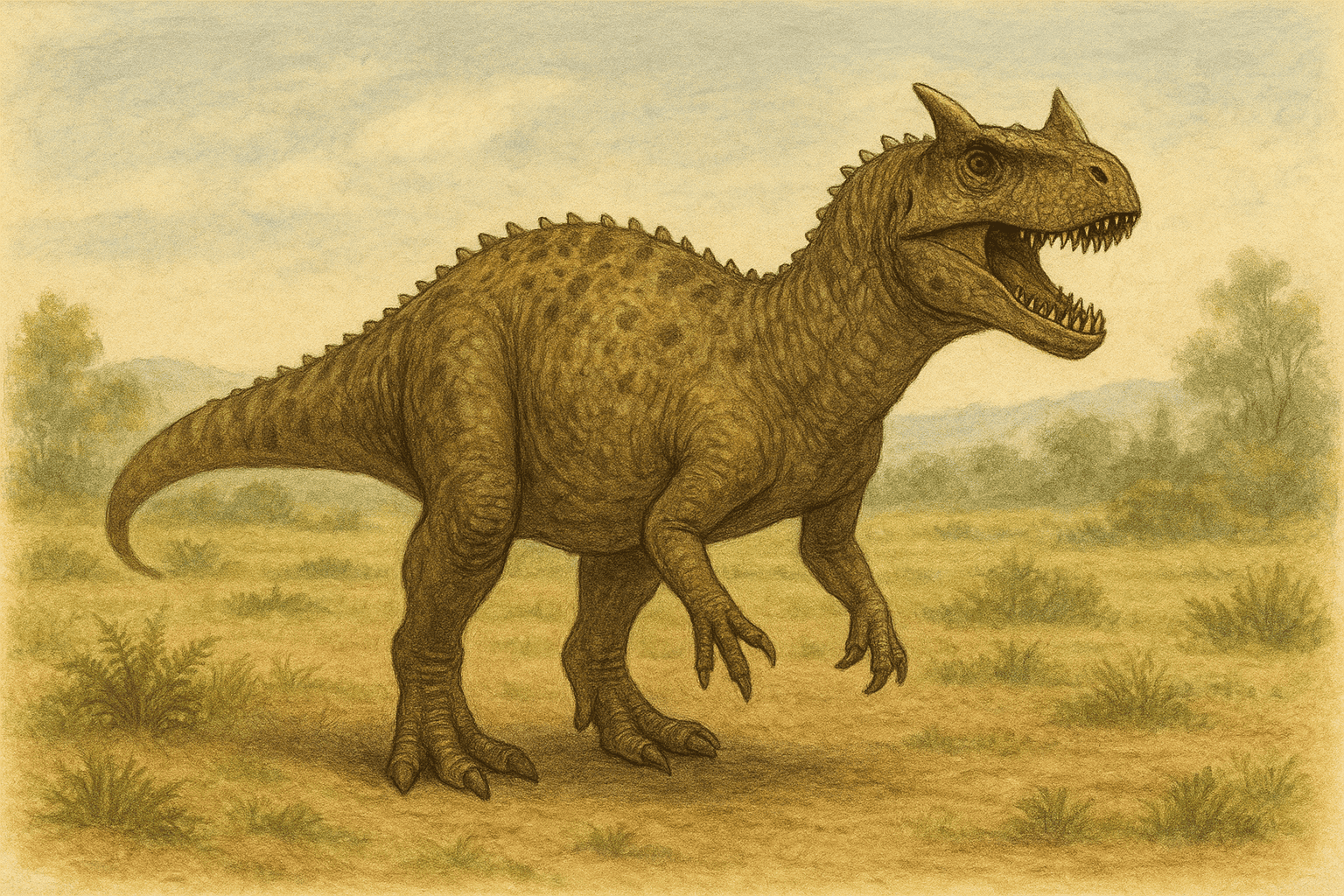
Ask most people to name a Jurassic predator and you’ll get Allosaurus. Maybe T. rex, even though that’s technically Cretaceous. What you almost never hear is Ceratosaurus — and that’s a shame, because this animal had a personality all its own.
Horn on its snout. Bony ridges down its spine. A hunting strategy built around patience and terrain rather than brute force. The Ceratosaurus dinosaur was doing things differently from every other large carnivore in its world — and it worked.
The Discovery That Put a Horn on the Map
In the late 1800s, paleontologist Othniel Charles Marsh was digging through Colorado’s Morrison Formation — one of the most productive fossil sites ever found in North America. He’d already pulled Stegosaurus, Apatosaurus, and Allosaurus from that same stretch of earth. Then came something with a horn growing straight out of its snout.
Marsh named it Ceratosaurus, meaning “horned lizard,” and the name stuck. The horn itself almost certainly wasn’t a weapon — it’s too small and too fragile for that. More likely it was used for display: attracting mates, intimidating rivals, recognizing members of the same species from a distance. Animals today use similar structures for exactly those reasons, from rhinoceros beetles to bighorn sheep.
Running alongside it were rows of small bony plates down the back — osteoderms — that made Ceratosaurus look unlike any other theropod in the formation. In my view, this is what makes it so visually compelling even today: it doesn’t look like a generic meat-eater. It looks like something that evolved on its own terms.
An Anatomy Built for a Specific Job
An accurate Ceratosaurus reconstruction shows something noticeably leaner than Allosaurus. About 20 feet long, with a flexible, almost sinuous body and a tail that made up a significant portion of its total length. It wasn’t built to overpower things head-on. It was built to move fast, strike hard, and get out.
The anatomy tells that story clearly:
- Slender, flexible frame — prioritized speed and maneuverability over mass
- Long, laterally compressed teeth — shaped for slicing through flesh, not crushing bone
- Short but powerful forelimbs — clawed and strong enough to hold struggling prey
- A deep, muscular tail — provided balance and powered rapid directional changes
There’s also a detail that doesn’t get nearly enough attention: fossil evidence points to Ceratosaurus being comfortable in and around water. It may have waded into rivers to catch fish or feed along the banks — something Allosaurus, with its heavier build, almost certainly didn’t do with the same ease. That’s not a minor footnote. It means Ceratosaurus had access to a whole food source its competitors couldn’t efficiently exploit.
A World It Shared With Creatures of Every Kind
Picture the Morrison Formation 150 million years ago: wide floodplains, dense forest along the rivers, massive sauropods moving in herds, Stegosaurus grazing in the open. It was a rich, complicated ecosystem — and Ceratosaurus was one piece of it.
Above all of it, early pterosaurs were already airborne. The more famous Pteranodon came later, in the Cretaceous, but its ancestors were already gliding over Jurassic landscapes while Ceratosaurus hunted below. These were the first vertebrates to achieve powered flight — a parallel evolutionary story unfolding in the same skies above the same rivers.
Ground, water, air — every niche was occupied. Ceratosaurus didn’t dominate all of them. It owned its corner of that world and made it work.
Why the Schleich Model Gets It Right
Walk into any serious dinosaur collector’s display and there’s a good chance you’ll find a Schleich Ceratosaurus somewhere on the shelf. The model earns its place. The nasal horn is proportioned correctly, the osteoderms along the back are rendered with care, and the posture reflects what we actually know about how this animal carried itself — not the tail-dragging lizard pose of older reconstructions.
Good dinosaur models matter more than people realize. A kid picking up that figure and asking “why does it have a horn?” is starting a conversation that a photograph in a textbook rarely triggers. The tactile experience makes the animal real in a way that’s hard to replicate any other way.
For educators, that’s genuinely useful. Accuracy in these models isn’t pedantry — it’s the foundation for real scientific curiosity.
The Real Takeaway From This Animal
The Ceratosaurus dinosaur survived for millions of years not because it was the strongest thing in its environment, but because it found a way to thrive that didn’t require head-to-head competition with animals twice its weight.
That strategy holds up under scrutiny:
- Specialization beats generalism — owning a niche is often more sustainable than competing for the top spot
- Different predators can share territory — if they’re hunting different prey in different ways, direct conflict is largely avoided
- Unusual anatomy usually means unusual behavior — the horn, the plates, the semi-aquatic tendencies all point to an animal that solved problems creatively
Allosaurus gets the fame. Ceratosaurus earned something arguably better: a genuinely interesting story.